Why Low-Quality Molded Fiber Packaging Damages Brand Perception — Even When the Product Is Protected
Introduction
Molded fiber packaging can protect the product and still damage the brand.
Both can pass transit testing.
Both can prevent damage.
But they do not deliver the same outcome.
One protects the product.
The other protects the brand.
The Mistake Most Teams Make
Packaging decisions are often evaluated on:
cost per unit
sustainability claims
basic performance
If the product arrives undamaged, the packaging is considered successful.
That assumption is incomplete.
Because customers don’t evaluate packaging in terms of pass/fail protection.
They evaluate it in terms of quality and intent.
This is why supplier selection should focus on production capability, not just cost.
What Customers Actually See
When a customer opens a box, they do not see:
fiber sourcing
cost optimization
internal trade-offs
They see:
surface quality
fit and consistency
how well the packaging aligns to the product
These details shape perception immediately.
The Two Outcomes
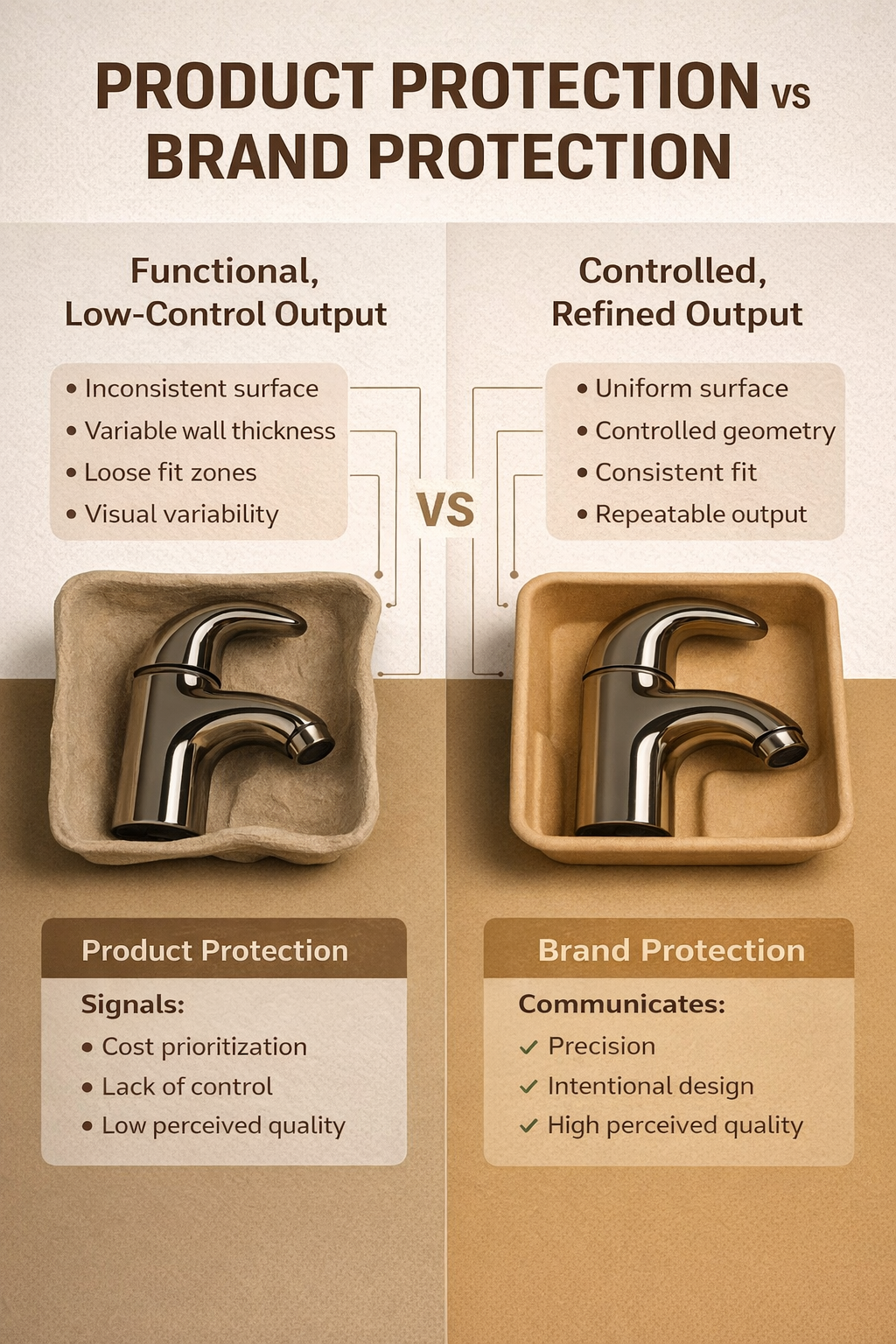
Tray A — Functional, Low-Control Output
inconsistent surface finish
loose or imperfect fit
visible variability
It performs its basic function.
But it signals:
cost prioritization
lack of control
low perceived quality
Tray B — Controlled, Refined Output
consistent geometry
clean surface definition
stable fit
It communicates:
precision
intentional design
alignment with product quality
Why This Happens
The difference is not just material.
It is the level of control applied across:
fiber preparation
forming consistency
tooling precision
drying discipline
Low-control systems produce variability.
This is where process control determines whether output is consistent or not.
Where the Risk Actually Sits
Most packaging programs are approved based on:
samples
initial production runs
At that stage, both trays can look acceptable.
The divergence happens at scale.
This is where most programs fail.
That is when:
variation increases
consistency drops
visual quality degrades
The packaging still protects the product.
But it no longer protects the brand.
The Commercial Impact
This is rarely measured directly, but it is real:
reduced perceived product quality
weaker unboxing experience
inconsistency across shipments
Over time, this erodes brand positioning.
Conclusion
In molded fiber packaging, the question is not:
“Does it protect the product?”
The real question is:
“Does it represent the brand the way you intended?”
Because customers will make that judgment immediately.
Common Questions About Molded Fiber and Brand Perception
Can molded fiber packaging protect a product but still damage the brand?
Yes.
Packaging can pass transit testing but still signal low quality through inconsistent surface finish, poor fit, and visible variability.
What do customers notice in molded fiber packaging?
Customers notice surface quality, fit, and consistency.
They do not see material sourcing or internal cost decisions.
Why does molded fiber variability affect perception?
Variability signals lack of control.
Even if the product is protected, inconsistent packaging reduces perceived quality.
When do molded fiber quality issues become visible?
At scale.
Small variations that are acceptable in sampling become noticeable across large production runs.
What drives high-quality molded fiber packaging?
Process control, tooling precision, forming consistency, and drying discipline.
These factors determine whether packaging is consistent and aligned with brand expectations.