Before You Commit to Molded Fiber
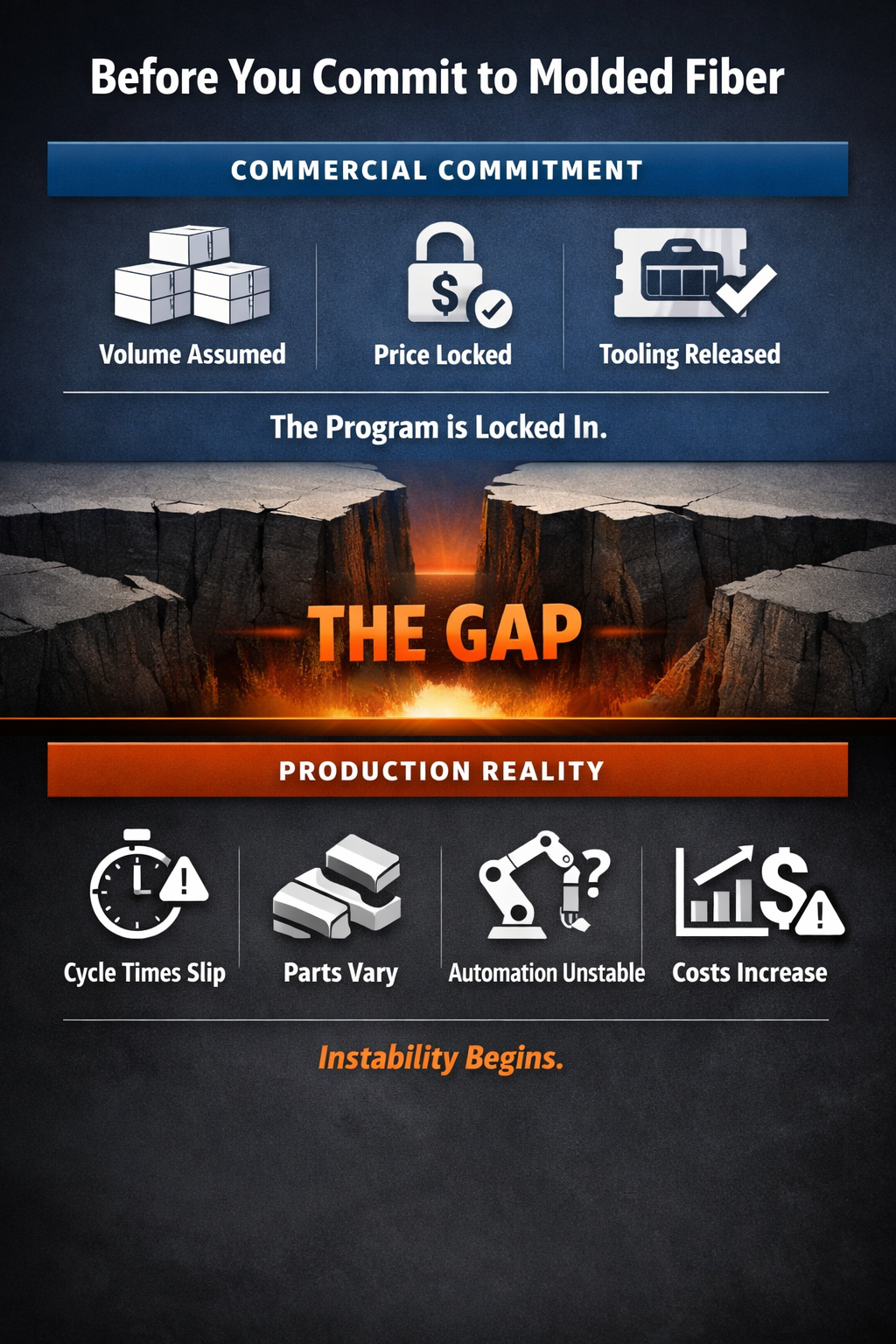
Most molded fiber programs do not fail in development.
They fail after commitment.
Volume gets assumed.
Price gets agreed.
Tooling gets released.
The program is locked.
Then production starts.
Where Programs Actually Break
Molded fiber programs are typically committed before three things are proven:
Volume
Forecasted demand is accepted without validating real production throughput.
Process
Cycle time, drying, and release behavior are assumed to hold beyond sampling.
Tooling
Tools are approved for form, not for long-term repeatability under production conditions.
What This Looks Like in Production
What was agreed commercially begins to break operationally:
cycle times slip under real conditions
parts vary across runs
automation becomes inconsistent
cost increases against a locked price
supply becomes unstable
These are not isolated issues.
They are the result of committing before the system was aligned.
Price is agreed before the system is proven.
That gap is where molded fiber programs break.
What Holds at Scale
Programs that perform consistently do one thing differently:
They validate before they commit.
volume is proven against actual capacity
process is defined under real operating conditions
tooling is built to hold over time
At scale, margin is not negotiated.
It is engineered through process stability.
Decision Point
The question is not:
Can molded fiber replace plastic?
The question is:
Can this run at the agreed price without breaking the system?
If production cannot support the price,
the system will fail before the program succeeds.
Technical Review
If you are evaluating a molded fiber program, or currently managing one:
I review active programs to identify where instability and margin erosion will show up before they do.
This includes:
production capability vs committed volume
pricing vs real operating conditions
tooling repeatability and lifecycle risk
Request a Technical Review
Final Close
Molded fiber is not a material decision.
It is a production and pricing risk decision.
Molded Fiber Program FAQs
Why do molded fiber programs fail at scale?
Molded fiber programs typically fail because commercial decisions are made before production conditions are fully validated.
Volume is assumed, price is agreed, and tooling is released before real operating performance is proven.
When production begins, instability appears in cycle time, part consistency, automation performance, and cost.
Why does price increase after a molded fiber program is launched?
Price increases occur when production cannot support the agreed cost structure.
If cycle times slow, scrap increases, or tooling does not hold, the cost to produce each part rises.
When price is locked before these variables are proven, margin erosion forces price adjustments or operational instability.
What causes inconsistency in molded fiber parts?
Inconsistency is typically caused by variation in process control rather than material.
Key drivers include:
uneven fiber distribution
inconsistent drying conditions
tooling wear or release issues
variation in cycle time
These factors become more pronounced at higher volumes.
Why do molded fiber parts fail in automation?
Molded fiber parts often fail in automation because they do not behave consistently under production conditions.
Small variations in geometry, moisture, or trimming can cause:
tracking issues
misalignment
unstable pick-and-place performance
Two parts may look identical but behave differently in automation.
What is the biggest risk when switching from plastic to molded fiber?
The biggest risk is treating molded fiber as a direct material replacement.
Molded fiber behaves as a production system, not just a material.
If process capability, tooling repeatability, and automation performance are not validated, the program will become unstable.
How can molded fiber programs be stabilized?
Programs that hold at scale validate three things before commitment:
volume against real production capacity
process performance under operating conditions
tooling durability and repeatability
Stability is achieved through alignment, not adjustment after launch.
When should molded fiber be used?
Molded fiber should be used when the production system can support consistent output at the required volume, cost, and performance level.
It is most effective when:
automation requirements are understood
tooling is designed for repeatability
demand is stable and predictable