The Real Shift in Molded Fiber Isn’t Material — It’s Precision
or years, most of the conversation around molded fiber has focused on material.
recycled content
sustainability positioning
alternatives to plastic
Those conversations are still relevant.
But they are no longer the most important shift happening in the industry.
The Shift Is in Execution
The most significant change is not what molded fiber is made from.
It’s how precisely it can now be produced.
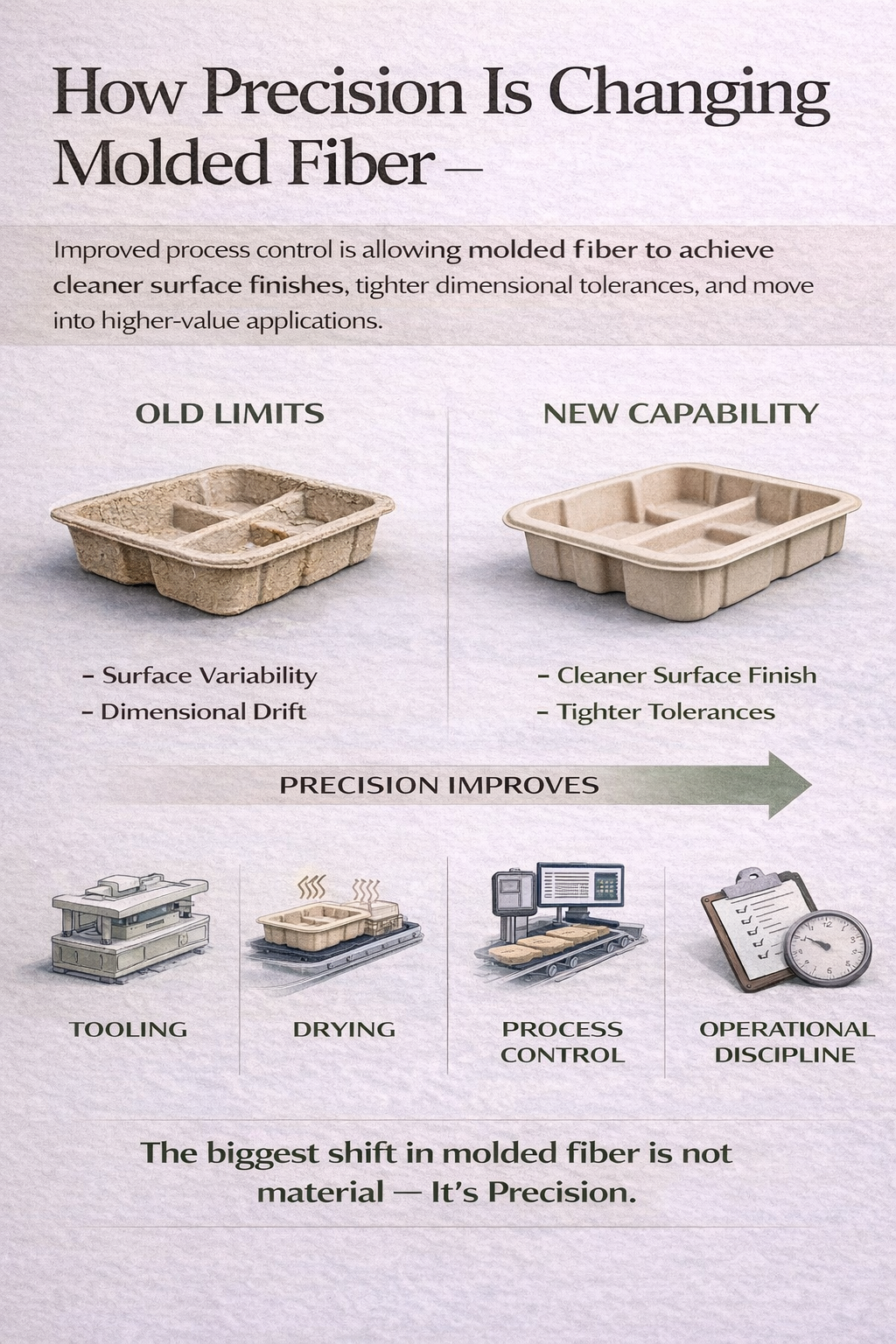
Advances across the manufacturing system are driving this shift:
tooling design
drying control
process consistency
production discipline
Individually, these are not new.
Collectively, they are changing what molded fiber is capable of.
What Precision Actually Changes
Historically, molded fiber carried inherent variability:
surface inconsistency
wider dimensional tolerances
limitations in fine detail
That variability defined where the material could be used.
As precision improves, those constraints begin to relax.
We are now seeing:
tighter dimensional control
cleaner, more consistent surface finishes
improved repeatability at scale
This is not incremental.
It changes the category.
Expanding the Application Envelope
As manufacturing precision improves, molded fiber is moving into applications that were previously considered out of reach.
These are applications that require:
structural performance
dimensional accuracy
visual consistency
In the past, those requirements defaulted to plastics or other engineered materials.
That assumption is beginning to shift.
Why This Is Happening Now
This shift is not driven by a single breakthrough.
It is the result of sustained improvement across multiple areas:
Tooling
More refined tool design enables:
better definition
improved material distribution
more stable forming
Drying
Improved drying control reduces:
warping
dimensional drift
variability across cycles
Process Control
Better control over forming conditions creates:
repeatable output
tighter tolerances
fewer defects at scale
Operational Discipline
Consistent execution across shifts and volumes ensures:
stability
predictability
scalable production
The Misconception About Innovation
Innovation in molded fiber is often framed as:
new materials
new blends
new sustainability claims
Those matter.
But they are not where the most meaningful progress is happening.
The real innovation is in:
consistency
control
execution
Doing the fundamentals better — and doing them repeatedly at scale.
The Commercial Impact
Precision changes more than technical capability.
It changes perception.
As molded fiber becomes:
more consistent
more refined
more predictable
It becomes viable in applications where:
aesthetics matter
tolerances matter
brand perception matters
This opens new commercial pathways.
Not because the material changed.
Because the execution did.
Conclusion
The biggest shift in molded fiber is not material innovation.
It is manufacturing precision.
As control improves, the limits of the material expand.
And with that, so does its role across packaging and product applications.
The implication is straightforward:
The future of molded fiber will not be defined by what it is made from.
It will be defined by how well it is made.