Choosing a Molded Fiber Supplier — Why Production Capability Matters More Than Price
Molded fiber supplier selection should be based on production capability, not unit price.
That’s expected. Price is easy to compare, easy to benchmark, and easy to communicate internally.
But in molded fiber programs, price alone rarely determines success.
The Real Constraint: Commercial-Scale Production
Most suppliers can produce acceptable early samples.
They can deliver parts that:
meet initial specifications
pass basic validation
support early-stage approvals
That is not where programs fail.
Programs fail when production scales.
Producing thousands of parts is one challenge.
Producing millions of consistent parts is another.
That is where manufacturing capability becomes visible.
Why Price Alone Is Misleading
Initial quotes reflect:
estimated cycle times
assumed yields
projected efficiencies
These assumptions are often based on controlled conditions.
They do not always reflect:
sustained production variability
equipment constraints
competing capacity within the plant
As a result, two suppliers with similar pricing can deliver very different outcomes at scale.
This is why pricing becomes unstable when production conditions change.
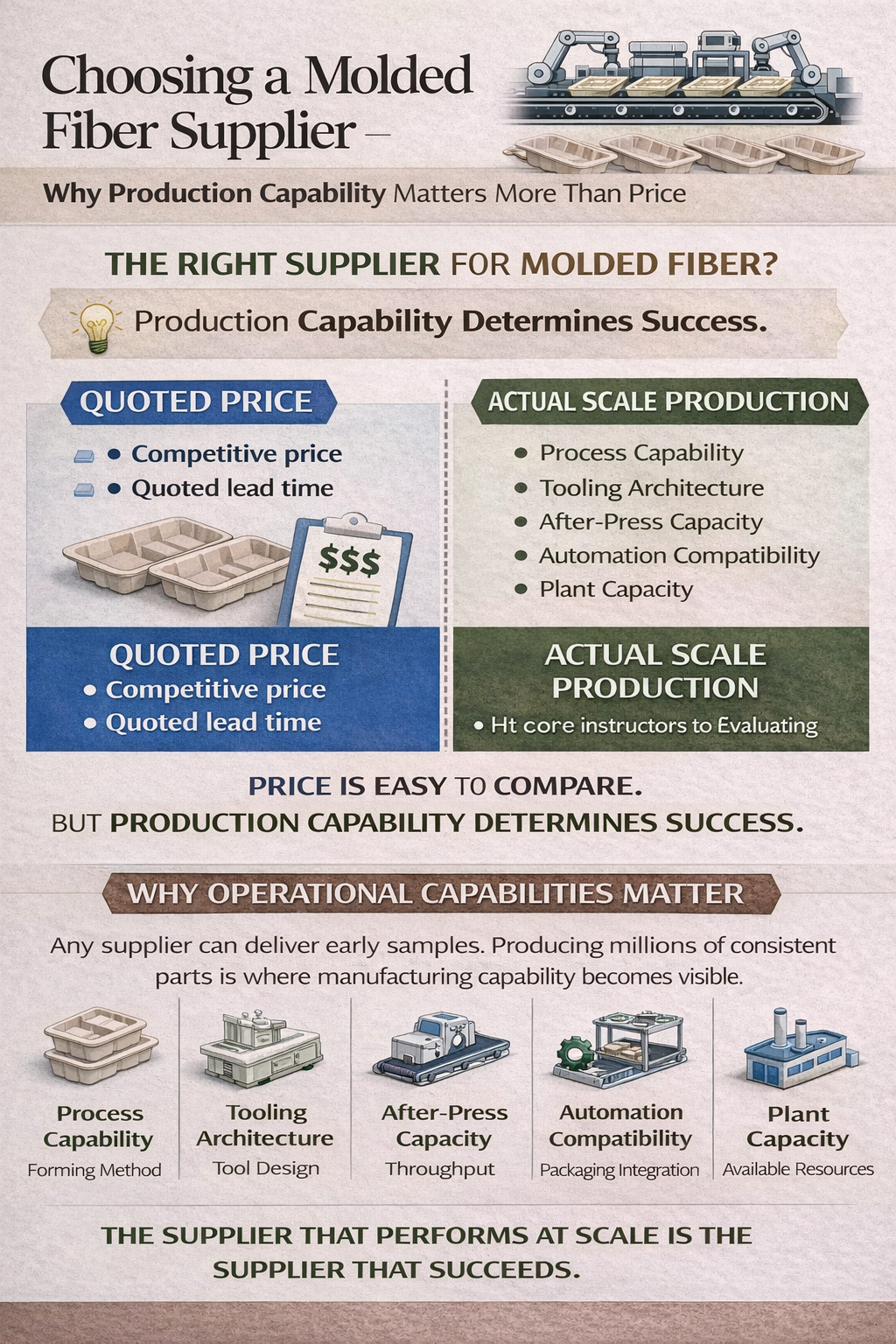
What Experienced Teams Actually Evaluate
Experienced packaging engineers and procurement teams focus less on price and more on operational fundamentals.
These determine whether a program stabilizes or struggles.
Process Capability
Molded fiber is not a single process.
Different forming methods produce different results in:
surface finish
dimensional tolerance
cycle time
cost structure
Understanding the supplier’s process capability is essential to predicting performance at scale.
Tooling Architecture
Tool design directly influences:
yield
cycle stability
ramp-up speed
Programs designed to run full platens typically deliver:
better throughput
more stable economics
improved consistency
Tooling decisions made early often define long-term performance.
After-Press Capacity
In many facilities, molding machines are not the constraint.
After-press capacity is.
Limited after-press capacity can:
cap total output
create bottlenecks
introduce variability across shifts
Understanding this constraint is critical when evaluating true production capability.
Automation Compatibility
Many molded fiber parts are integrated into automated packaging systems.
This introduces additional requirements:
dimensional stability
repeatable geometry
consistent part presentation
Parts that perform well in manual handling environments may fail in automated systems.
Plant Capacity
Quoted capacity and real capacity are not always the same.
True capacity depends on:
number of molding lines
available after-press stations
drying capacity
number of active programs already running
Without this context, capacity claims can be misleading.
The Scale Transition
The most important transition in any molded fiber program is the move from:
validated sample → sustained production
This is where:
variation increases
process limitations appear
operational constraints become visible
Suppliers that perform well at low volume do not always perform at scale.
The Key Insight
Price is easy to compare.
Production capability is harder to evaluate.
But it is what determines whether a molded fiber program actually works.
Conclusion
Choosing a molded fiber supplier is not just a sourcing decision.
It is a manufacturing decision.
The correct question is not:
“Who offers the lowest price?”
It is:
“Who can deliver consistent performance at the volumes required?”
Because in molded fiber, success is not defined by the first parts produced.
It is defined by the millionth.