Why Molded Fiber Pricing Becomes Unstable Without Volume Commitment
Overview
Molded fiber pricing becomes unstable when production cadence breaks.
In practice, it is a function of how that volume behaves in production.
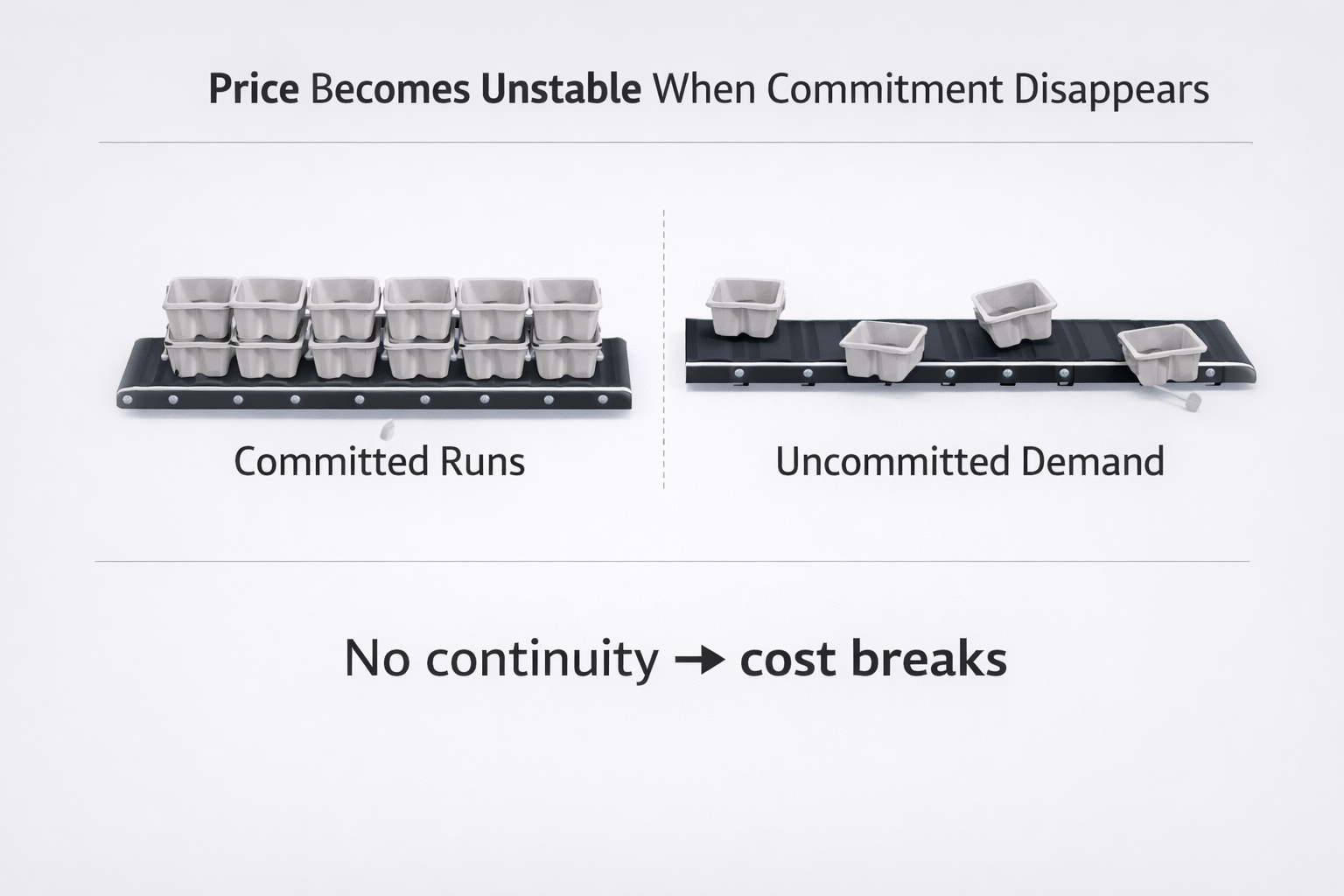
Price becomes unstable when commitment disappears.
What Breaks
Most molded fiber programs do not fail on lower demand.
They fail on unstable execution.
Orders shrink.
Forecasts lose credibility.
Releases lose cadence.
Production shifts to stop-start batches.
Run length shortens.
The line loses density.
What Happens Next
Unit cost increases.
Changeovers multiply.
Idle time expands.
At that point, the cost structure resets.
This is the same pattern seen when programs fail at scale.
What This Means for Pricing
Stable pricing requires stable production.
Stable production requires committed volume.
Blanket orders and defined releases are what create that stability.
Decision Implication
No commitment means no continuity.
No continuity means no cost control.
Molded fiber is priced on production certainty.
Remove commitment and the price will move.
Common Questions About Molded Fiber Pricing
Why does molded fiber pricing become unstable?
Molded fiber pricing becomes unstable when production cadence breaks.
Unpredictable orders force stop-start production, reducing efficiency and increasing cost.
Pricing follows production stability, not just volume.
Does lower volume reduce molded fiber cost?
Not necessarily.
Lower volume combined with inconsistent scheduling increases changeovers and idle time.
This reduces efficiency and can increase unit cost instead of lowering it.
What drives cost in molded fiber production?
Cost is driven by production stability.
Continuous runs with consistent scheduling maximize efficiency.
Stop-start production increases labor, energy, and changeover cost.
What is a blanket order and why does it matter?
A blanket order commits volume over time with defined release schedules.
It allows suppliers to maintain stable production cadence, which controls cost.
Without it, pricing becomes unstable.
Why do suppliers increase pricing when demand is inconsistent?
Inconsistent demand reduces efficiency.
Short runs, more changeovers, and idle time increase unit cost.
Pricing adjusts to reflect that higher cost structure.