WHY MOLDED FIBER PROGRAMS BREAK AT SCALE
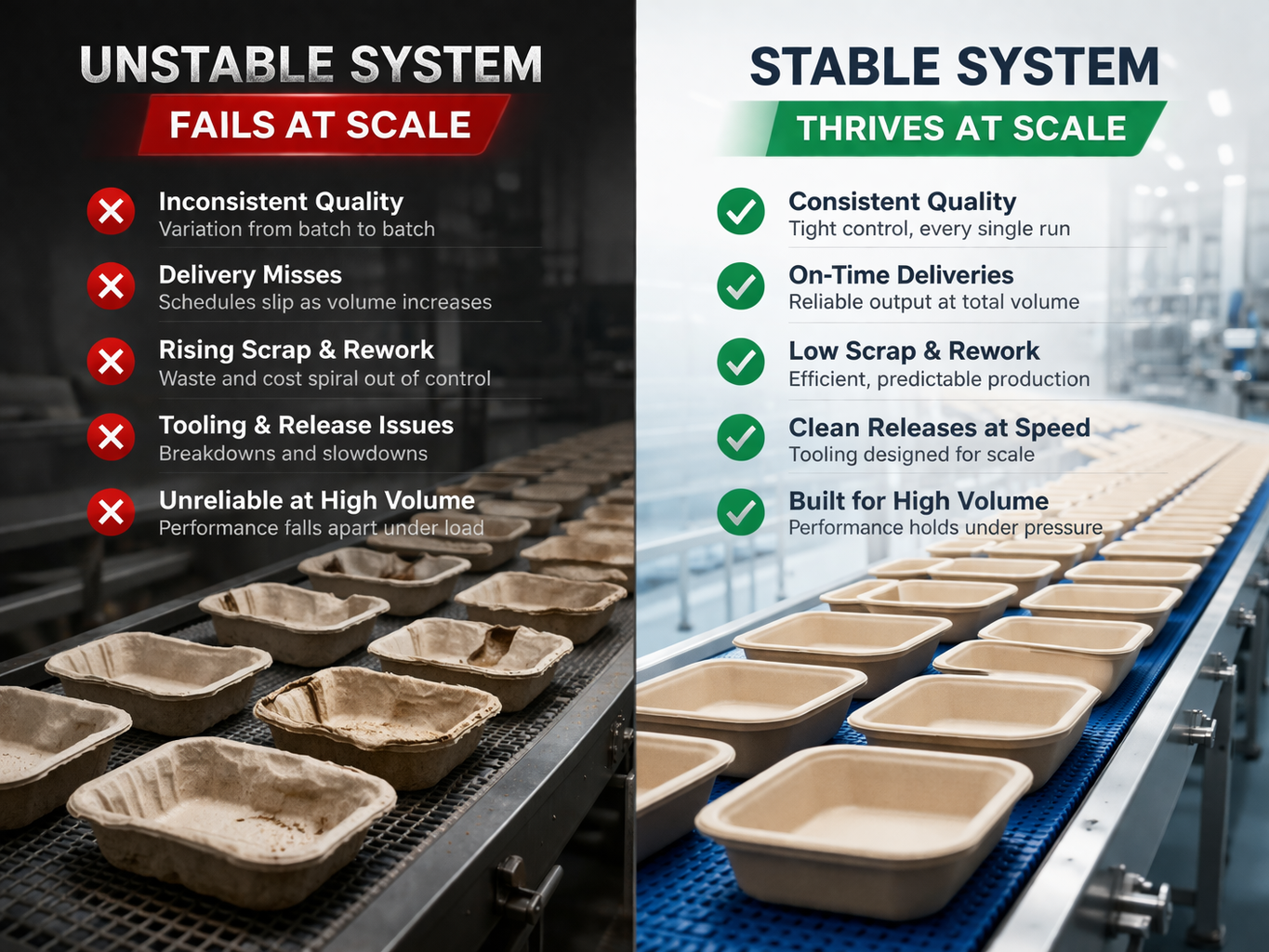
Molded fiber programs fail at scale when production stability breaks.
At small volumes, the system can absorb instability.
At scale, it cannot.
What changes at scale
When volume increases, the requirements change:
cycle time must stabilize
fiber distribution must remain consistent
tooling must release cleanly across thousands of cycles
drying must stay within a narrow operating window
What worked in sampling or pilot runs no longer holds.
Where breakdown actually occurs
Programs rarely fail because of material.
They fail when production loses control.
That usually shows up as:
inconsistent part weight
dimensional variation
surface defects
release issues at higher speeds
increased scrap and rework
At low volume, these issues are manageable.
At scale, they compound.
The underlying issue
Scale amplifies instability.
If process control is not tight, variation increases.
If tooling is not optimized for sustained cycles, performance degrades.
If production cadence is inconsistent, cost structure resets.
This is where pricing becomes unstable.
This is not random.
It is structural.
Why most teams miss it
Most decisions are made based on:
sample quality
quoted unit cost
initial trial performance
But none of those reflect:
sustained cycle behavior
long-run tooling performance
production consistency under load
The system is evaluated at its best, not at its limits.
This is why supplier selection should focus on production capability, not just price.
What actually determines success at scale
Programs that hold at scale are built on:
stable process control
tooling designed for repeatability, not just geometry
controlled production cadence
alignment between engineering and production constraints
Without that, scale introduces failure.
The takeaway
Molded fiber does not break at scale.
Uncontrolled systems do.
Common Questions About Molded Fiber at Scale
Why do molded fiber programs fail at scale?
Molded fiber programs fail at scale when production stability breaks.
Variability increases, tooling performance degrades, and process control becomes more difficult to maintain.
What changes when molded fiber production scales?
Cycle time, drying consistency, and tooling performance must stabilize.
Small variations that are manageable at low volume become systemic issues at scale.
Why do parts that pass sampling fail in production?
Sampling occurs under controlled conditions.
At scale, sustained cycles expose process limitations, tooling wear, and production variability.
What causes variability in molded fiber production?
Inconsistent fiber distribution, unstable process control, tooling limitations, and drying variation.
These factors compound as production volume increases.
Can molded fiber programs be validated at low volume?
Only partially.
Low-volume validation does not reflect long-run production behavior or system stability under continuous operation.