How EPR Is Changing Packaging Economics - And Why Design Decisions Now Determine Future Cost
Extended Producer Responsibility (EPR) is often positioned as a sustainability policy.
In practice, it is a cost allocation system.
And it is beginning to reshape how packaging decisions are made.
The Shift: From Sustainability Narrative to Cost Structure
Historically, packaging decisions have been evaluated based on:
material cost
performance requirements
supply chain efficiency
End-of-life impact was acknowledged, but rarely priced directly into the decision.
EPR changes that.
What EPR Actually Does
EPR programs assign responsibility for waste management back to the producer.
That responsibility is not theoretical.
It is financial.
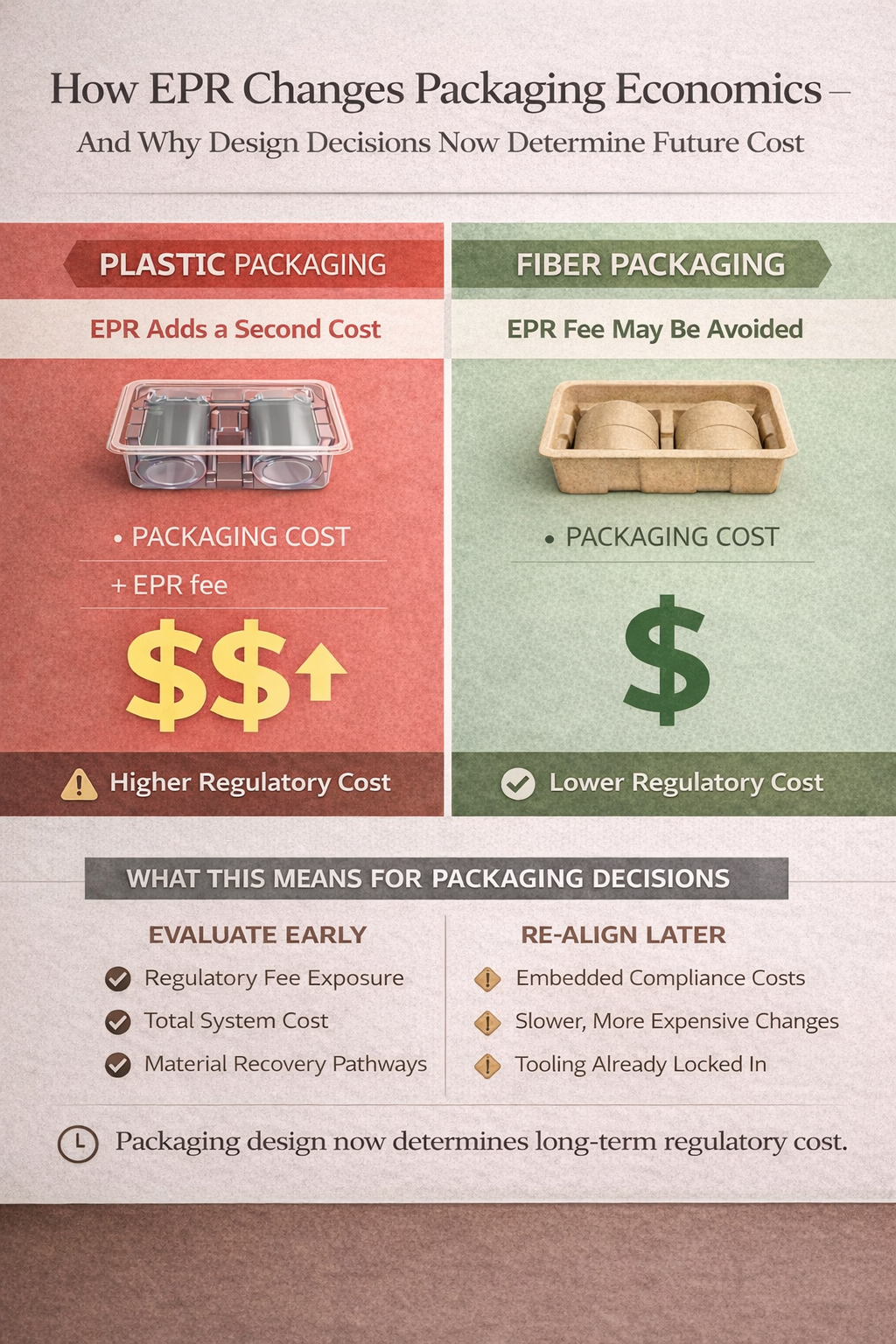
This creates a second layer of cost tied directly to packaging choice:
Primary cost: the packaging itself
Secondary cost: the EPR fee associated with material recovery, recycling, or disposal
Some materials now carry both.
Others carry less.
Why This Matters Now
This is not a future issue.
It is already influencing how packaging is evaluated in regulated markets.
And it will expand.
The key shift is this:
Packaging design decisions now determine regulatory cost exposure.
The Strategic Mistake
Many companies are still evaluating packaging using traditional frameworks:
lowest unit cost
acceptable performance
sustainability positioning
Without accounting for how that same packaging will be treated under EPR.
That creates risk.
Because once fee structures are implemented:
costs become embedded
supply chains are already aligned
tooling is already deployed
At that point, changing packaging becomes:
slower
more expensive
more disruptive
The Advantage of Early Evaluation
Companies that incorporate EPR into packaging decisions early gain flexibility.
They can:
model total system cost, not just unit price
evaluate materials before regulatory costs are locked in
align design with future compliance requirements
This is a structural advantage, not a marginal one.
Why Molded Fiber Is Getting Renewed Attention
One outcome of this shift is increased interest in molded fiber packaging.
Not because it is universally better.
But because in many applications, it aligns more favorably with:
recyclability
material recovery pathways
lower EPR fee exposure in certain regions
That said, material selection is still application-dependent.
The Constraint Still Exists
EPR does not eliminate core packaging requirements.
Performance still matters.
protection
durability
fit within automation systems
Total cost still matters.
production
logistics
operational efficiency
The difference is that regulatory cost is now part of that equation.
The New Evaluation Framework
Packaging decisions are no longer just:
“What protects the product at the lowest cost?”
They are becoming:
“What protects the product while minimizing total system cost — including regulatory exposure?”
The Forward-Looking Question
The most relevant question is no longer tied to current cost.
It is tied to future treatment:
How will this material be treated under EPR five years from now?
Conclusion
EPR is not simply influencing packaging decisions.
It is redefining them.
Packaging is no longer just a material and performance decision.
It is a cost structure decision shaped by regulation.
And increasingly, those costs are determined long before the product ever ships.